


SOLVE YOUR DOUBTS
UNLOCK THE SECRETS OF LITEBALL STRATEGY WITH OUR TACTIC FAQ´S
Elevate your game by mastering the art of positioning, shot selection, and outsmarting your opponents.
EASY ACCESS
Click on each question block to access the explanation.

When learning to play LiteBall, understanding how to interact with the Non-Volley Zone (NVZ) is essential for moving from a beginner to an intermediate player.
Moreover, once you understand how the NVZ works, you can use it to your advantage and execute more advanced shots. If you have never played LiteBall, the NVZ rules might seem complicated, but they are actually quite simple in practice and quickly become second nature. When in doubt, just remember: unless the ball has bounced, stay out of the NVZ!
The NVZ applies only in Doubles. In Singles, volleys are permitted throughout the entire court.
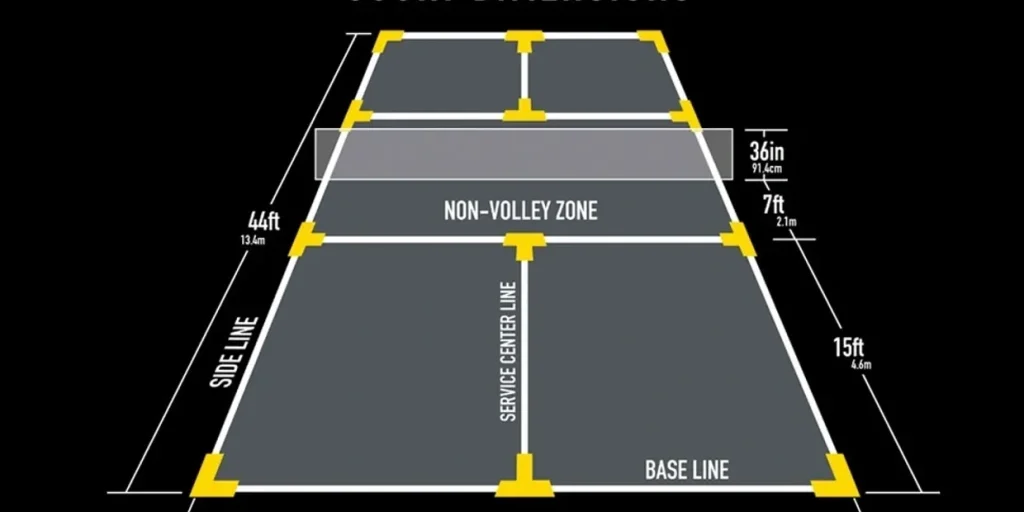
The Non-Volley Zone, officially referred to as the Non-Volley Zone (or NVZ for short), is the area located 2.13 meters from each side of the net, and the line marking its location is called the NVZ line.
Some of the most intense and exciting sequences in LiteBall happen in this part of the court, and many scoring opportunities arise within the NVZ.
A standard LiteBall court measures 13.41 meters long by 6.1 meters wide. The NVZ covers the area 2.13 meters from the net on each side and extends from side to side.
This means that on each side of the net, the NVZ measures 2.13 meters deep and 6.1 meters wide, giving a total area of 42.67 square meters.
This rule applies not just when your racket hits the ball but also if you enter the NVZ during your swing, from start to finish. Even if your opponent hits the next shot, if your momentum takes you into the NVZ, it’s a fault.
Due to these rules, experienced players often execute an “Outside” shot as a way to volley within the NVZ without breaking the rules!
The lines marking the edge of the NVZ are considered part of the NVZ itself, which means you cannot volley while touching any of these lines—this includes both the NVZ line and the sidelines.
No part of your body or equipment can touch the NVZ during the entire volley movement. This includes your racket hitting the NVZ area during a low shot.
Fortunately, the NVZ refers only to the area on the ground and does not include the space above! Therefore, your body or racket can cross the plane of the NVZ line, as long as nothing touches the ground within its boundaries.
Nothing you touch can be in the NVZ during a volley: If you volley and hit your doubles partner whose foot is on the NVZ line, you will have committed a fault.
No clothing can fall into the NVZ during a volley: In addition to your body and racket, if any clothing or other equipment you are wearing, like a hat or sunglasses, falls into the NVZ during a volley, it’s a fault.
Both feet must be on the ground outside the NVZ: Both feet must be outside the NVZ before making a volley. Although this may seem obvious, this rule targets players who are in the NVZ to hit a shot and need to quickly exit before another shot is sent to them.
You must have both feet on the ground outside the NVZ if you are required to make a volley!
The service area includes the NVZ line, the center line, the sidelines, and the baseline. The center, sidelines, and baseline are all considered “in” or good if a service ball lands on them.
The NVZ line, however, is considered “out.”
This means a serve must completely clear the NVZ line to be considered a valid serve.
You can do whatever you want in the NVZ! You can hit any type of shot from inside the NVZ, as long as the ball bounces first.
Although it may not be a good strategy, you can hit a forehand from the NVZ, or a dink, or a lob.
You can move freely within the NVZ and stay there as long as you like, as long as you are not volleying.
In doubles, one teammate can be inside the NVZ while the other volleys, as long as you don’t hit each other while making the shot.
Just remember that as long as you are not volleying in the NVZ, you are not breaking LiteBall’s NVZ rules.
A “Dink” is a softer LiteBall shot, usually played close to the NVZ line. It is hit with control and finesse over the net and is intended to land in the opponent’s NVZ—keeping the ball close to the net and forcing your opponent to let it bounce.
A well-placed dink can force your opponent to reposition.
This creates scoring opportunities by making it difficult for your opponent to volley and by moving them until you see an opening.
Patience is key, so keep the ball low to prevent your opponent from making a powerful volley or even a smash.
They might even return the ball by lifting it, which could allow you to attack.
Whether you use a Dink as part of an offensive strategy or as a defensive shot, it will give you time to move to a better position and help keep your opponent on the move.
The NVZ serves several purposes in LiteBall and forces players to play more strategically rather than staying at the net and hitting the ball aggressively at their opponents.
It is an essential rule for maintaining the enjoyment of extended rallies and strategic play, and players must learn to rely on better movement and shot placement if they want to outplay their opponents.
The “Outside” shot is an advanced move that can be devastating when used correctly.
It is difficult to master but involves quickly moving the player outside the sideline to volley when the ball comes into the NVZ.
Since the player is not technically in the NVZ, it is a perfectly legal move!
When executing this shot, the player never touches the NVZ.
The LiteBall rules state that players cannot hit the ball in the air while standing in the NVZ or touching the NVZ line, but this line does not extend beyond the sidelines.
So, if you are standing outside the court lines next to the NVZ, it is legal to volley.
Just make sure not to hit the ball from the opponent’s side or cross to the other side of the net while the ball is still in your side.
LiteBall® is a registered international trademark protected by intellectual property laws. Any commercial use requires prior written authorization. © 2027 LiteBall. All rights reserved.